Corrective orthodontics in Palma
Corrective orthodontics straightens the permanent teeth and corrects the bite. It usually starts from the age of 12, once all the permanent teeth have come through, although it is also done in adults.
Adolescence is a good time for it: the teeth are already in place and the bone still responds well to movement, so treatment is usually simpler than in an adult. At Clínicas Udemax we provide it at our clinics in Palma with braces or Invisalign aligners, and your first visit is free.
Usual age to start
Metal, self-ligating or sapphire
Also with clear aligners
First visit and diagnosis
Book your free first orthodontic consultation
We assess the teeth and bite, explain which techniques are possible and give you a plan with timeframes and a quote.
Leave us your details and we will call you back within three hours.
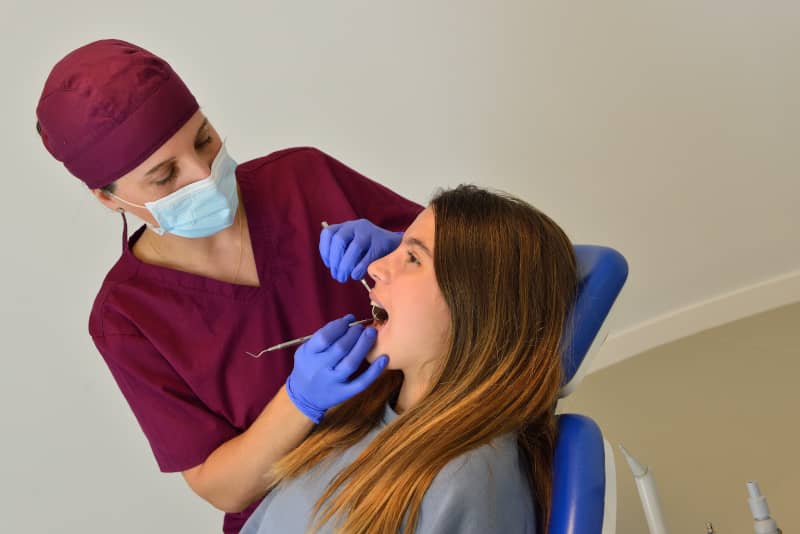
What is corrective orthodontics?
It is also called comprehensive or second-phase orthodontics. Its aim is to put each tooth in its place and make the two arches fit together properly when biting, to improve function, the health of teeth and gums, and the appearance of the smile.
It is the last of the three stages of orthodontics in childhood and adolescence:
- Preventive, from 3 to 6 years: habits such as dummy use or thumb sucking are monitored, and spaces are kept if a baby tooth is lost early.
- Interceptive, from 6 to 12 years: jaw growth is guided while it is still possible.
- Corrective, from age 12: the permanent teeth are straightened and the bite is adjusted.
Not every child goes through all three. Many only need corrective treatment, and in others interceptive treatment makes the corrective phase shorter or simpler.
What problems does it correct?
Corrective orthodontics treats the most common tooth position and bite problems:
- Crowded, rotated or crooked teeth.
- Gaps between the teeth.
- Overbite, when the upper teeth cover too much of the lower teeth.
- Crossbite, open bite or scissor bite.
- Very prominent upper teeth, or lower teeth in front of the upper teeth.
- A shifted midline between the upper and lower teeth.
Corrective orthodontics at our clinics in Palma
Orthodontics
Udemax Miramar
Outpatient department, Hospital Juaneda Miramar
Camí de la Vileta, 30 · 07011 Palma
- Monday to Thursday
- 9:00–13:00 · 16:00–20:00
- Friday
- 9:00–20:00
By car
Paid parking at the Hospital Juaneda Miramar car park, a one-minute walk away, plus street parking. There is also free parking on Camí de la Vileta, about a 10-minute walk away.
Go to the car parkBy bus
EMT bus routes 6, 8 and 29, stopping at "Policlínica", in front of the hospital.
View bus routeBy taxi
Taxi ranks at Camí de la Vileta, 51 and Carrer de Pasqual Ribot, 1.
Orthodontics
Emardental
Carrer d’Alfons el Magnànim, 2, ground floor
Bons Aires · 07004 Palma
- Monday to Thursday
- 9:00–13:00 · 16:00–20:00
- Friday
- 9:00–13:00
By car
Street parking and the Santa Pagesa underground pay car park (Carrer d’Ausiàs March, 26), a 4-minute walk away. There is also a pay car park at s’Escorxador, about a 5-minute walk away.
Go to the car parkBy bus
EMT bus routes 12, 20, 24 and 40, stopping at "Pl. d’Abú Yahya", "Alfons el Magnànim" or "31 de desembre".
View bus routeBy taxi
Taxi rank at Plaça d’Abú Yahya, 2.
Orthodontics
Arcdental
Carrer de Sevilla, 8, ground floor
Son Dameto · 07013 Palma
- Monday and Wednesday
- 16:00–20:00
- Tuesday
- 9:00–13:00 · 16:00–20:00
- Thursday
- 13:00–19:00
- Friday
- 15:00–19:00
By car
Street parking and the pay car park at Hospital Juaneda Miramar, a 3-minute walk away. There is also free parking on Camí de la Vileta, about a 10-minute walk away.
Go to the car parkBy taxi
Taxi ranks at Carrer de Son Espanyolet, 58 and Carrer de Pasqual Ribot, 1.
Corrective orthodontic techniques
The technique depends on the case, how discreet you want treatment to be and the patient's commitment. These are the options:
Metal braces
The most durable and affordable option, highly effective even in complex cases. Teenagers can choose the colour of the elastics.
Metal bracesSelf-ligating braces
Smaller braces with a clip instead of elastics, such as the Damon system. They create less friction and check-ups are quicker.
Self-ligating bracesSapphire braces
Clear braces that don't stain, for anyone who wants fixed orthodontics that is less noticeable.
Sapphire bracesInvisalign
Clear, removable aligners. Invisalign Teen includes wear indicators to check that the aligners are worn for the 22 hours a day needed.
Invisible orthodonticsWhat does treatment involve?
Assessment and plan
At your first visit we carry out a study with X-rays, photographs and a 3D scan to see how the teeth and jaws fit together.
We then explain which techniques are possible, roughly how long treatment will take and the quote.
Treatment
We fit the braces or hand over the aligners. With braces, check-ups are usually every 4 to 6 weeks to adjust the wire; aligners are changed every one or two weeks.
The length of treatment depends on how complex the case is. As a guide, it usually takes between 12 and 24 months.
Retention
When the braces come off or the aligners are finished, we fit a fixed retainer behind the teeth or a removable one to wear at night. Without retention, teeth tend to move back.
What if I am an adult?
Corrective orthodontics has no age limit: an adult with healthy teeth and gums can straighten their teeth. Treatment may take a little longer than in a teenager, and if the problem lies in the jawbones, it is combined with orthognathic surgery.
You can read about all the options for adults on our orthodontics in Palma page.
Caring for your teeth during treatment with braces
Braces easily trap food. To avoid decay and gum problems during treatment:
- Brush after every meal and use interdental brushes to clean around the braces and under the wire.
- Avoid very hard or sticky foods, such as whole nuts, toffees or chewing gum, which can dislodge the braces.
- Wear a mouthguard if you play contact sports.
- If a bracket comes loose or a wire is rubbing, let us know and we will fix it.
- Don't miss your check-ups: they keep treatment on track.
Frequently asked questions about corrective orthodontics
At what age does corrective orthodontics start?
Usually from the age of 12, once all the permanent teeth have come through. In adults it can be done at any age, as long as the teeth and gums are healthy.
How long does it take?
It depends on how complex the case is. As a guide, it usually takes between 12 and 24 months. At your first visit we give you the estimated timeframe for your case.
Do braces hurt?
They don’t hurt, but for the first few days after fitting and after each adjustment it is normal to feel pressure and some tenderness when chewing. It usually passes within a few days.
Braces or Invisalign for a teenager?
Both work. Invisalign is more discreet and comfortable, but it only works if the teenager wears the aligners for around 22 hours a day. Braces work on their own. At the first visit we assess which suits the case and your child best.
How much does corrective orthodontics cost?
It depends on the technique and how long treatment takes. In general, metal and self-ligating braces are the most affordable options. At your free first visit we give you a detailed quote, and you can finance your treatment.
What is the difference from interceptive orthodontics?
Interceptive orthodontics works on jaw growth between the ages of 6 and 12. Corrective orthodontics straightens the permanent teeth from the age of 12, when growth is almost complete.
Who will treat you
Corrective orthodontics is led by Dr Cristina Martínez-Almoyna Rifá, who works alongside periodontics or oral and maxillofacial surgery when a case requires it.