Orthodontics for children in Palma de Mallorca
Orthodontics for children monitors and corrects the development of the teeth and jaws as your child grows. Spotting a bite problem in time means it can be treated when it is simplest, taking advantage of growth, and stops it getting worse.
At Clínicas Udemax we have a children's dental clinic, Arcdental, where orthodontics and paediatric dentistry work together. Your child's first check-up is free.
Our children's dental clinic in Palma
Recommended age for the first check-up
Preventive, interceptive and corrective
First check-up and diagnosis
Book your child’s free first orthodontic check-up
We check your child’s teeth, bite and growth, and explain whether they need treatment now, later on or just monitoring.
Leave us your details and we will call you back within three hours.
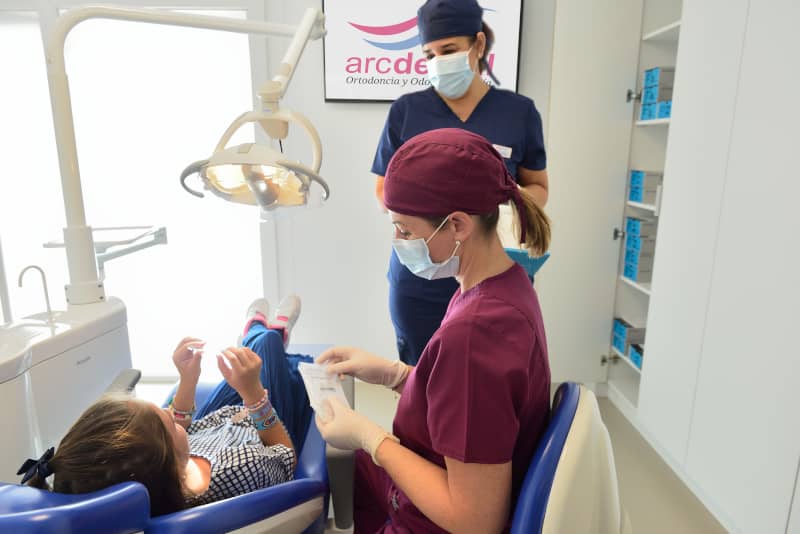
What does orthodontics for children correct?
During growth we can treat problems with the teeth and jawbones:
- Crowded, crooked or gapped teeth.
- Crossbite, open bite and scissor bite.
- A narrow palate.
- A retruded (Class II) or protruding (Class III) lower jaw.
- Lack of space for the permanent teeth to come through.
- Habits that change the shape of the mouth, such as thumb sucking, prolonged dummy use or mouth breathing.
When should you take your child to the orthodontist?
We recommend a first orthodontic check-up at around age 7, even if you don't notice anything unusual. Book sooner if your child:
- Bites with the lower teeth in front of the upper teeth, or to one side.
- Has very prominent upper teeth or a very retruded chin.
- Breathes through the mouth, snores or sleeps with the mouth open.
- Still uses a dummy or sucks their thumb after the age of 3 or 4.
- Has lost baby teeth very early, or the permanent teeth are coming through crooked or without room.
Orthodontics for every age
Treatment depends on age and whether the problem lies in the teeth or the bones. That is why orthodontics for children is organised in stages:
Ages 3 to 6
Preventive orthodontics: we monitor habits such as dummy use or thumb sucking, and keep the space with space maintainers if a baby tooth is lost early.
Ages 6 to 12
Interceptive orthodontics: we guide jaw growth with appliances such as palatal expanders, while it is still possible.
Interceptive orthodonticsFrom age 12
Corrective orthodontics: once all the permanent teeth are through, we straighten them and adjust the bite with braces or aligners.
Corrective orthodonticsDiscreet for teenagers
Invisalign Teen clear aligners, with wear indicators to check they are worn for the hours needed.
Invisible orthodonticsWhere to find Arcdental
We provide orthodontics for children at Arcdental, our children's dental clinic in Palma, where development is monitored together with paediatric dentistry.
Our children's dental clinic
Arcdental
Carrer de Sevilla, 8, ground floor
Son Dameto · 07013 Palma
- Monday and Wednesday
- 16:00–20:00
- Tuesday
- 9:00–13:00 · 16:00–20:00
- Thursday
- 13:00–19:00
- Friday
- 15:00–19:00
By car
Street parking and the pay car park at Hospital Juaneda Miramar, a 3-minute walk away. There is also free parking on Camí de la Vileta, about a 10-minute walk away.
Go to the car parkBy taxi
Taxi ranks at Carrer de Son Espanyolet, 58 and Carrer de Pasqual Ribot, 1.
What does orthodontics for children involve?
First check-up
We examine the teeth, the bite and facial growth, and take photographs and X-rays if needed.
We explain whether your child needs treatment now, later on or just regular check-ups.
Treatment
If treatment is needed, we fit the right appliance for their age and problem, fixed or removable, and adjust it at regular check-ups.
For the first few days it is normal for children to notice the appliance when talking or eating, but they adapt quickly.
Follow-up and retention
We monitor development until all the permanent teeth have come through. At the end of any treatment, a retainer keeps the teeth in place.
Why do baby teeth matter?
Baby teeth hold the space for the permanent teeth and guide them as they come through. If one is lost early, through decay or a knock, the neighbouring teeth can move and leave no room for the permanent tooth.
In these cases, a space maintainer prevents the problem. That is why it is so important to look after baby teeth and attend paediatric dentistry check-ups.
Tips for parents
Some habits help your child's mouth develop well:
- Try to phase out the dummy at around age 2 or 3.
- If your child still sucks their thumb after age 4, mention it at the check-up.
- Notice whether they breathe through the mouth or snore: it can affect how the palate develops.
- If they wear an appliance, they should brush after every meal and avoid hard or sticky foods.
- If they play contact sports with an appliance, they should wear a mouthguard.
To find out more, our blog explains when children can get braces and how aligners work for children.
Frequently asked questions about orthodontics for children
At what age should a child see an orthodontist?
We recommend a first check-up at around age 7, when the permanent teeth start to come through. This allows jaw growth problems to be detected in time, although many children won’t need treatment until later.
What orthodontic treatments are there for children?
It depends on age: from 3 to 6, preventive orthodontics; from 6 to 12, interceptive orthodontics to guide jaw growth; and from 12, corrective orthodontics with braces or aligners.
Braces or aligners for my child?
In young children whose jaws are still growing, specific appliances such as expanders are usually used. In teenagers both braces and Invisalign Teen work, as long as the teenager wears the aligners for around 22 hours a day.
How often are the check-ups?
With fixed appliances or braces, usually every 4 to 6 weeks. With aligners, visits are usually further apart. If your child is only being monitored, check-ups are even less frequent.
Can my child eat normally?
Yes, although with fixed appliances it is best to avoid very hard or sticky foods, such as whole nuts, toffees or chewing gum, and to brush after every meal.
Will the results last?
Yes, as long as the retention phase is followed. Teeth tend to move over time, so a fixed or removable retainer is fitted at the end of treatment.
How much does orthodontics for children cost?
It depends on the appliance and the length of treatment. At the free first check-up we give you a detailed quote, and you can finance your treatment.
Can my child have orthodontics with gingivitis?
The gum inflammation needs to be treated first. Once it is under control, orthodontic treatment can begin, coordinated with paediatric dentistry or periodontics.
Who will treat your child
Orthodontics for children is led by Dr Cristina Martínez-Almoyna Rifá and Dr Ana Ledesma Pavón, working together with our paediatric dentistry team.