
Pulpectomy in children in Palma
A pulpectomy is the treatment that saves a baby tooth when decay or a knock has completely damaged the nerve. All the pulp, the inner part containing the nerve and blood vessels, is removed, the tooth is disinfected and filled, so it can stay in the mouth until the permanent tooth comes through.
We carry it out at Arcdental, our children's dental clinic in Palma, under local anaesthetic so your child feels no pain. Keeping the baby tooth prevents space and alignment problems in the permanent teeth.
Usual length of treatment
Done under local anaesthetic
To keep them until they are replaced
First visit and diagnosis
Book an appointment with our paediatric dentist
If your child has toothache, a darkened tooth or a gum abscess, we assess the case, take an X-ray and explain what treatment they need.
Leave us your details and we will call you back within three hours.
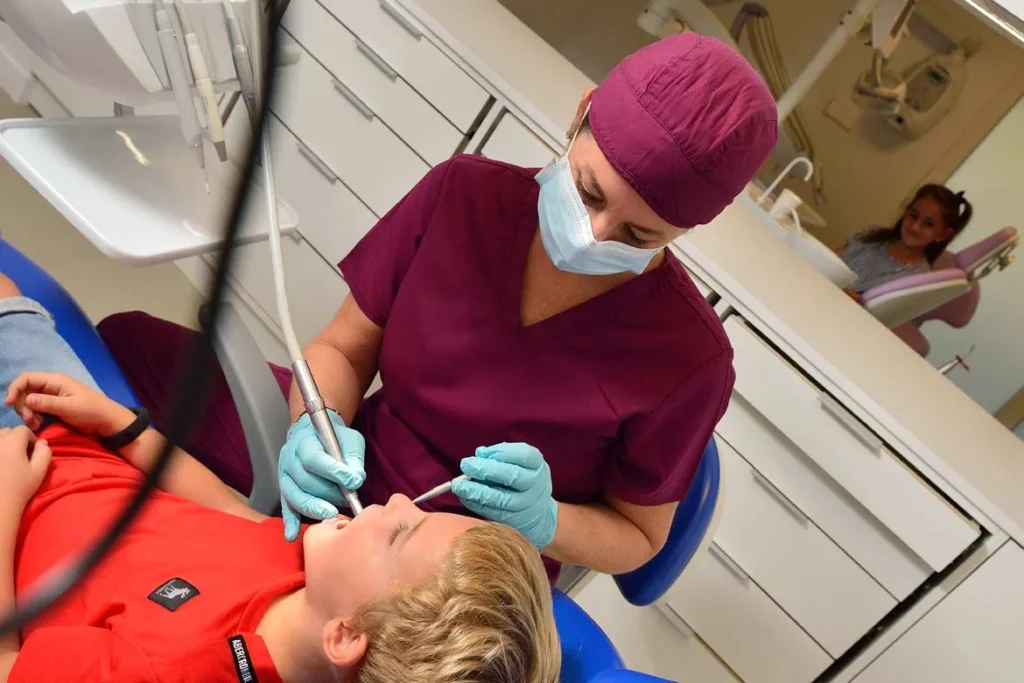
What is a pulpectomy?
It is root canal treatment for baby teeth. When infection or inflammation reaches the pulp in the root and cannot recover, all the pulp is removed from the crown and the roots, the canals are cleaned and disinfected, and then filled.
In baby teeth, the canals are filled with a resorbable material that dissolves along with the root, so it does not interfere when the tooth falls out and the permanent tooth comes through. In permanent teeth, the equivalent treatment is a root canal.
Pulpotomy or pulpectomy?
These are two similar treatments that differ in how much pulp has to be removed:
Pulpotomy: only the pulp in the crown, the upper part of the tooth, is removed, because the pulp in the roots is still healthy. It is the most common treatment for deep decay in baby teeth.
Pulpectomy: all the pulp is removed, including the pulp in the roots, because the infection or inflammation has reached them.
The X-ray and examination of the tooth tell us which one your child needs.
When might your child need one?
These signs suggest that decay or a knock may have affected the nerve of the tooth. If you notice any of them, book an appointment:
Persistent pain
Pain that doesn't go away, or that appears when chewing or with cold, heat or sweet things.
Pain at night
Pain that comes on by itself or wakes your child usually means the nerve is badly affected.
Dark or grey tooth
A baby tooth that changes colour may have a damaged nerve, often after a knock.
Gum abscess or lump
Swelling or a small pimple with pus next to the tooth means an infection has spread from inside the tooth.
Knock to a tooth
After a knock, the nerve can be damaged days or weeks later, even if the tooth looks fine at first.
Very deep decay
A large cavity close to the nerve may need pulp treatment to save the tooth.
How is a pulpectomy carried out?
Diagnosis
We examine the tooth and take an X-ray to see how far the decay or infection goes, and check the state of the root and of the permanent tooth forming underneath.
From this we decide whether a pulpotomy, a pulpectomy or, if the tooth cannot be saved, an extraction is best.
Cleaning and filling
Under local anaesthetic, we isolate the tooth with a rubber dam to keep it dry and clean. We remove all the pulp, clean and disinfect the canals and fill them with a resorbable material.
Treatment usually takes 30 to 60 minutes, depending on the tooth.
Restoration
We seal the tooth with a filling or, if it has lost a lot of structure, with a paediatric crown that protects it from fracture until it falls out naturally.
Aftercare following a pulpectomy
After treatment, your child can carry on as normal. Just bear in mind:
- Don't eat until the anaesthetic wears off, a few hours, so they don't bite their lip or cheek without realising.
- Make sure they don't bite or play with the numb area.
- If they feel some discomfort in the first few days, they can take the pain relief we recommend.
- Avoid very hard or sticky foods on that side for the first day.
- Keep brushing as normal, including the treated tooth.
- Call us if there is swelling, fever or pain that gets worse.
Why not just take out the baby tooth?
Because baby teeth hold the space for the permanent teeth. If one is lost early, the surrounding teeth can shift and leave no room for the tooth that has to come through, which can cause alignment problems.
That is why we try to save the tooth whenever possible. If it is not possible and the tooth has to come out, we consider fitting a space maintainer and monitor development with our children's orthodontics team.
Who will treat your child
Pulpectomies are carried out by our paediatric dentists, Dr Cristina Martínez-Almoyna Rifá, Dr Maria Morro and Dr Ana Ledesma Pavón.



Where to find Arcdental
We carry out pulpectomies at Arcdental, our children's dental clinic in Palma.
Our children's dental clinic
Arcdental
Carrer de Sevilla, 8, ground floor
Son Dameto · 07013 Palma
- Monday and Wednesday
- 16:00–20:00
- Tuesday
- 9:00–13:00 · 16:00–20:00
- Thursday
- 13:00–19:00
- Friday
- 15:00–19:00
By car
Street parking and the pay car park at Hospital Juaneda Miramar, a 3-minute walk away. There is also free parking on Camí de la Vileta, about a 10-minute walk away.
Go to the car parkBy taxi
Taxi ranks at Carrer de Son Espanyolet, 58 and Carrer de Pasqual Ribot, 1.
Frequently asked questions about pulpectomy in children
Is a pulpectomy painful?
No. It is done under local anaesthetic, so your child feels no pain during treatment. We go at their pace and explain every step. Afterwards they may feel some mild discomfort, which can be managed with the pain relief we recommend.
How long does a pulpectomy take in children?
It usually takes 30 to 60 minutes, depending on the tooth and how affected it is. It is normally done in a single visit.
Is a pulpectomy dangerous?
No. It is a common and safe treatment in paediatric dentistry. What can cause problems is leaving an infection in a baby tooth untreated, as it can spread and affect the permanent tooth forming underneath.
What is the difference between a pulpotomy and a pulpectomy?
In a pulpotomy only the pulp in the crown of the tooth is removed, because the pulp in the roots is healthy. In a pulpectomy all the pulp is removed, including the roots, because the infection has reached them.
When is a pulpectomy better than an extraction?
When the baby tooth still needs to stay in the mouth for some time and the root is in good condition. If the root is very resorbed, the tooth is about to fall out or the infection is very extensive, it may be better to extract it and, if needed, fit a space maintainer.
What aftercare does my child need?
Don’t eat until the anaesthetic wears off, make sure they don’t bite the numb area and avoid hard foods on that side for the first day. Brushing carries on as normal. If there is swelling or fever, call us.
Is it covered by PADI?
PADI does not cover root canal treatment in baby teeth, only extractions and urgent treatment of pain or infection. It does cover root canal treatment in permanent teeth. More information on our PADI page.
How much does a pulpectomy cost for a child?
It depends on the tooth and whether it needs a filling or a paediatric crown. At the free first visit we give you a detailed quote, and you can finance your treatment.
What if my child is very scared?
We go at their pace and explain everything in simple words. If their anxiety is very intense, we can carry out treatment under conscious sedation.