Fixed prostheses (crowns) on implants
En este artículo
- Key conclusions
- What is a fixed dental crown?
- In which cases is a fixed dental crown recommended?
- Types of fixed dental crowns: materials and uses
- Step-by-step treatment for a fixed dental crown at Udemax
- How long does a fixed dental crown last?
- Care and maintenance of a fixed dental crown
- Approximate price of a fixed dental crown in Mallorca
- Fixed dental crowns at Udemax Clinics (Palma de Mallorca)
- Frequently asked questions about fixed dental crowns
Losing tooth structure – whether due to deep tooth decay, an unexpected fracture or the natural ageing process – affects both the functionality of the mouth and the appearance of our smile. A fixed dental crown is one of the most reliable solutions in modern dentistry: it restores the shape, strength and natural appearance of a damaged tooth or an implant replacing a missing tooth. In this article, we explain everything you need to know before having a dental crown fitted in Mallorca, from the materials available to the full procedure we follow at Udemax Clinics.
Key conclusions
- A fixed dental crown is a non-removable prosthesis that covers the entire surface of a tooth or implant to restore function and appearance.
- Crowns can last between 15 and 30 years with proper care and regular check-ups.
- The treatment is usually completed in 2–3 appointments: initial assessment, preparation of the tooth with a temporary crown, and fitting of the permanent crown.
What is a fixed dental crown?
A dental crown is, to use its technical term, an individual prosthetic restoration designed to restore the tooth to its original anatomy.
A dental crown is a fixed prosthesis that completely covers the visible part of a tooth or the abutment of an implant. Dental crowns are a fixed, non-removable prosthesis: once cemented in place, the patient cannot remove them. They form part of the group of fixed dental prostheses, which also includes bridges (several crowns joined together) and veneers. Unlike veneers, which cover only the front surface, a dental crown covers the entire surface of the tooth, making them more invasive than dental veneers but also more protective.
A dental crown is custom-made in a dental laboratory to match the colour, shape and size of the patient’s natural teeth, ensuring it blends in seamlessly with the rest of the dentition. It is used both to strengthen teeth weakened by structural damage and to improve the aesthetics of the smile by correcting its appearance, proportions or shade.
In which cases is a fixed dental crown recommended?
At Udemax Clinics, we assess each case on an individual basis. The dentist and prosthodontist evaluate whether the best option is a crown, an inlay, a veneer, an implant or another type of fixed prosthesis, taking into account the remaining tooth structure, the area of the mouth and the patient’s expectations.
The most common situations are:
- Extensive tooth decay that has destroyed a large part of the tooth, making a conventional filling no longer a viable option.
- Tooth fractures caused by trauma – such as during sport – which affect several surfaces of the tooth.
- Teeth that are severely worn down due to bruxism, acid erosion or vigorous chewing.
- Teeth that have undergone root canal treatment and require additional protection to prevent fracture.
- Replacement of missing teeth using an implant-supported crown.
- Cosmetic treatments for incisors and canines: to correct shape, colour or minor misalignment.
Crowns protect damaged teeth from needing to be extracted, whilst also improving the appearance of the smile. Crowns restore the tooth’s chewing function, allowing the patient to eat normally again.
Strengthening damaged or root-treated teeth
Following root canal treatment, the tooth loses its vitality and becomes more fragile. In such cases, a crown plays a vital role. Teeth that have undergone root canal treatment, particularly molars, often require a crown to prevent a fracture that would necessitate extraction, as crowns are used to strengthen damaged teeth. A fixed crown acts as a protective cap when a significant amount of tooth structure is missing due to decay or wear. This situation is common in patients aged between 35 and 65 who suffer from bruxism, prolonged mouth opening or have a history of extensive restorations.
Support for bridges and fixed dentures
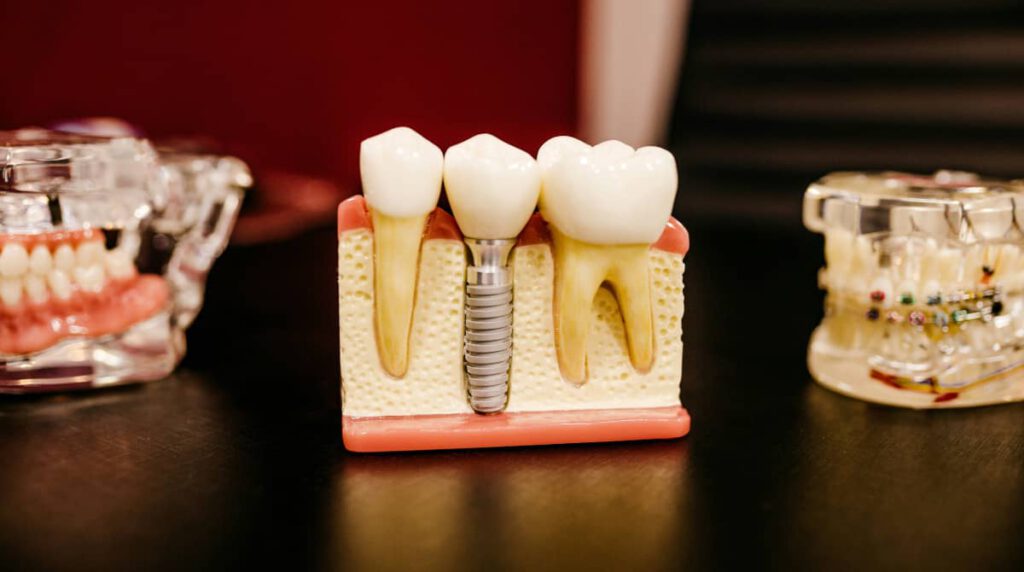
A fixed bridge is a structure consisting of several crowns joined together to replace one or more missing teeth. The parts that are supported by the adjacent teeth are called abutments. The crowns at either end act as abutments on natural teeth or implants, whilst the middle section, known as the pontic, replaces the missing tooth. This type of fixed prosthesis is recommended when there are small edentulous spaces, such as the loss of a premolar between two healthy teeth. At Udemax Clinics, we plan the number of crowns, pontics and abutments using a digital bite analysis to ensure a precise fit.
Fixed crown on dental implants
When a tooth has been completely lost, a titanium implant is placed in the jawbone. A crown is then fitted onto this implant to replace the missing tooth. The crown may be screw-retained or cemented to the implant abutment, depending on the clinical case, the location and ease of access for oral hygiene. This option avoids the need to grind down healthy neighbouring teeth, unlike some conventional bridges. At Udemax Clinics, implant surgery and the subsequent fitting of the fixed crown are planned digitally to ensure greater precision.
Types of fixed dental crowns: materials and uses
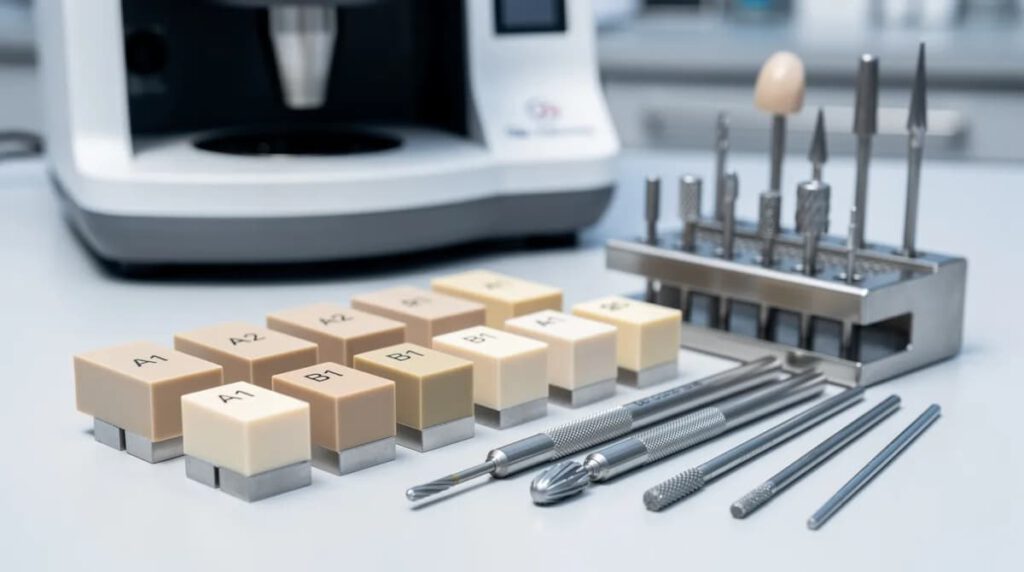
There are different types of crowns depending on the material and the area of the mouth where they are fitted. Crowns can be made of ceramic, resin or zirconia, and the choice is based on a combination of aesthetic considerations, strength, biocompatibility and budget. At Udemax, we work with a state-of-the-art dental laboratory in Mallorca and use CAD/CAM systems that enable highly precise design and milling.
The most common materials in 2024–2026 are: monolithic zirconia, lithium disilicate, feldspathic ceramics and metal-porcelain.
Zirconia and all-ceramic crowns
Zirconia crowns mimic the natural appearance of the tooth thanks to their translucency and their ability to reflect light in a similar way to enamel. They are the most aesthetic option on the market, allowing the colour to be matched to that of the neighbouring teeth and providing an imperceptible transition in the smile. Zirconia is particularly durable; according to clinical studies, its 5-year survival rate exceeds 97 per cent, comparable to that of metal-porcelain crowns. Meanwhile, lithium disilicate crowns are recommended for anterior teeth due to their exceptional lustre and transparency. At Udemax, these crowns can be made of zirconia or porcelain to enhance aesthetics in visible areas and are the most recommended option for comprehensive aesthetic restorations in the anterior and premolar regions.
Metal-porcelain crowns
Metal-porcelain crowns combine a metal base on the inside with an outer porcelain layer that mimics the colour of the tooth. They are durable and aesthetically pleasing, making them a common solution for molars and less visible posterior areas, where chewing function is the priority. However, over the years, if the gums recede, a slight greyish edge may become visible, an aspect to bear in mind for front teeth. This option offers good value for money when the priority is the functionality and durability of the restoration.
Temporary resin crowns
Temporary crowns are temporary resin or acrylic caps used between appointments. They are fitted to protect the prepared tooth whilst the permanent crown is being made. These temporary restorations maintain the tooth’s appearance and allow the patient to speak and chew normally throughout the process. They are generally worn for between 1 and 4 weeks, depending on the complexity of the case and the time required by the laboratory to fabricate the permanent crown. As they are less durable than permanent crowns, it is recommended that patients avoid very hard or sticky foods during this period to prevent damage or displacement.
Step-by-step treatment for a fixed dental crown at Udemax
The standard procedure at our dental clinic is usually completed in 2–3 appointments over a period of 1–3 weeks. The protocol may vary slightly depending on whether the crown is being fitted onto an implant or a natural tooth. We use digital X-rays and, where necessary, a 3D intraoral scanner to plan every detail.
First appointment: diagnosis and treatment plan
The process includes a radiological examination prior to placement, together with an oral examination and a full medical history, to assess the condition of the tooth or implant. First, the possible treatment options are analysed – such as a filling, inlay, crown or removable denture – with the aim of finding the most conservative and effective solution. In addition, the most suitable type of material is selected – whether zirconia, ceramic or metal-porcelain – depending on the location, the occlusal load and the patient’s aesthetic expectations. The initial assessment at Udemax Clinics is free of charge and includes an indicative quote. Professionals trained at leading institutions, such as the Complutense University of Madrid, are involved in planning the most complex cases.
Tooth preparation and impression taking
Local anaesthetic is administered to ensure that the tooth preparation is completely painless. Tooth preparation involves reducing the tooth by up to 2 millimetres all round to create sufficient space for the crown material. Following preparation, an impression is taken – either using traditional methods (silicone) or via a digital scanner of the entire dental arch. The bite is also recorded to ensure a good fit with the opposing teeth.
Fitting the temporary crown
- During the same appointment, a temporary resin crown is cemented in place to protect the prepared tooth and maintain its appearance. The temporary crown allows the patient to speak and eat with reasonable ease whilst the laboratory fabricates the permanent crown. In addition, the patient is given clear instructions on oral hygiene, diet and what to do if the temporary crown comes loose. At Udemax Clinics, we offer a personalised service and explain each step so that no one leaves with any doubts.
Fitting and cementing of the permanent crown
Fitting the permanent crown requires a second appointment, or a third if an interim fitting is needed. At this appointment, the fit, contact with the neighbouring teeth, colour and overall fit of the crown are checked. Minor adjustments are made in the surgery to adapt the bite and prevent discomfort when chewing. Once everything is correct, the crown is cemented in place using a high-strength permanent dental cement. The patient leaves the clinic with their chewing function restored and a appearance very similar to that of natural teeth. Crowns can be fitted onto both natural teeth and implants, following the same fitting and cementing protocol.
How long does a fixed dental crown last?
The average lifespan of a modern fixed crown is between 15 and 20 years, although crowns can last between 15 and 30 years with proper care. Dental crowns can last for more than 10 to 15 years, even under demanding conditions of use.
Durability depends on several factors:
Factor | Impact on duration |
|---|---|
Material (zirconium, ceramic, metal-porcelain) | State-of-the-art ceramic materials offer greater resistance to wear and tear |
Cement quality and cementing technique | Poor marginal sealing can lead to leakage and secondary caries |
Condition of the tooth or supporting implant | A healthy, well-prepared abutment extends the life of the crown |
Patient habits | Bruxism, chewing ice, smoking or poor oral hygiene can shorten the lifespan |
According to a systematic review of 55 clinical studies, 5-year survival rates range from 90.7 per cent (feldspar ceramics) to 96.6 per cent (reinforced lithium disilicate).
At Udemax, we recommend check-ups every 6–12 months to detect marginal caries, gum problems or bite misalignments. For patients diagnosed with bruxism, we advise the use of a night-time bite splint.
Care and maintenance of a fixed dental crown
A fixed crown is looked after in much the same way as a natural tooth, but requires special attention to the margin between the gum and the prosthesis:
Caring for a fixed dental crown is essential to ensure its durability and good condition. It is recommended that you brush your teeth two or three times a day using a medium- or soft-bristled toothbrush, paying particular attention to the gum line to prevent plaque build-up. It is also important to use dental floss or interdental brushes around the crown to prevent the development of tooth decay in the abutment tooth, as good oral hygiene is crucial for maintaining the durability of a dental crown. At Udemax Clinics, we recommend having professional cleanings every 6–12 months to remove tartar and check the condition of fixed restorations. It is also advisable to avoid habits such as opening containers, biting pens or breaking excessively hard foods with crowned teeth, as these actions can cause the ceramic veneer to fracture. Finally, it is essential to attend a check-up if you notice any looseness, sensitivity or a change in colour around the crown area, so that any potential problems can be detected early.
Approximate price of a fixed dental crown in Mallorca
Prices vary depending on the material used, whether the crown is fitted over a natural tooth or an implant, and the complexity of the case. At Udemax Clinics, these are the current indicative price ranges:
Type of crown | Approximate price |
|---|---|
Metal-porcelain crown | €290 |
Zirconia crown | €500 |
Lithium disilicate crown | €500 |
Temporary crown on a tooth | €60 |
Dental pin | €60 |
These prices apply to single crowns on natural teeth. Crowns on implants may incur an additional cost for the prosthetic abutment and connecting elements.
At Udemax, we provide a personalised, no-obligation quote following a diagnostic assessment. We also offer financing options and instalment plans to make high-quality fixed dentures more accessible, ensuring that cost is not a barrier.
Fixed dental crowns at Udemax Clinics (Palma de Mallorca)
Udemax Clinics is a network of dental clinics in Palma de Mallorca with over 40 years of family-run experience, led by the Martínez-Almoyna doctors. We have specialists in fixed prostheses, implantology and cosmetic dentistry who work in a coordinated manner on each case in general and on complex situations in particular. We use advanced technology, including digital radiography, 3D planning and CAD/CAM systems to design crowns with the utmost precision and a result that respects each patient’s anatomy. We offer a personalised service, explaining each step of the treatment to the patient, and the initial assessment appointment is free of charge. You can book an appointment online via our website or call us on 971 767 521 between 8.30 am and 8.00 pm. We also have an emergency number available outside normal opening hours.
Frequently asked questions about fixed dental crowns
Does it hurt to have a fixed dental crown fitted?
The tooth is prepared and the restoration fitted under local anaesthetic, so the procedure should not be painful. It is normal to experience slight sensitivity or pressure for the first few days, which usually subsides on its own. At Udemax, we tailor the dose of anaesthetic to each patient and, if necessary, prescribe mild pain relief. If the discomfort persists for more than a week, we recommend coming in for a check-up so that we can adjust your bite.
Can you tell the difference between the crown and the natural teeth?
With modern materials such as zirconia and all-ceramic restorations, the result is usually virtually imperceptible. The colour of the neighbouring teeth is used as a reference, and trials are carried out before the final cementation. In highly visible areas, we pay particular attention to shape, shine and translucency to ensure the restoration blends seamlessly into the smile. The dental laboratory that Udemax works with takes a bespoke approach to each individual case.
Can I eat normally with a fixed crown?
Once the restoration has been cemented in place and adjusted, the patient can eat practically anything. During the first few days, it is best to avoid very hard or sticky foods whilst the bite settles in. In cases of bruxism, a bite splint is recommended, and special care should be taken with bones, hard sweets and similar items. If you experience pain when chewing, it is important to attend a check-up for minor adjustments to the bite.
What happens if the crown comes loose or breaks?
If the crown comes loose, keep it clean and visit the clinic as soon as possible to have it refitted. It is not advisable to use household adhesives or homemade cements. If the structure fractures, the dentist will assess whether it can be repaired or whether a new one needs to be made. At Udemax, we prioritise treatment for this type of emergency to prevent the tooth from being left unprotected.
Are there any alternatives to a fixed dental crown?
Depending on the case, large fillings, inlays/onlays, veneers or bridges may be considered. When the tooth is severely damaged, a crown is usually the safest and most durable option. If the tooth cannot be saved, the alternative is extraction followed by the placement of an implant with a fixed crown. At Udemax, we always explain all the viable options so that the patient can make an informed decision.