
Retrognathia (retruded lower jaw): what it is, causes and treatment

En este artículo
- The essential points
- What is retrognathia?
- Retruded lower jaw or retruded upper jaw?
- How do you know if you have retrognathia?
- Causes of retrognathia
- Consequences of a retruded jaw
- Retrognathia in babies and children
- Until what age does the lower jaw grow?
- Retrognathia treatment
- Can a retruded jaw be corrected without surgery?
- Retrognathia treatment at Clínicas Udemax
- Frequently asked questions about retrognathia
During childhood and adolescence the jaws grow, and with them the shape of the face and the position of the teeth take form. That growth is not always balanced: sometimes the lower jaw develops too much (prognathism) and sometimes it stays short or set back. The latter is retrognathia, or a retruded lower jaw.
Spotting it early makes a real difference. In children, interceptive orthodontics can use growth to guide the jaw forward. In adults, when the problem lies in the bone, the solution usually combines orthodontics and surgery.
The essential points
- Retrognathia is a lower jaw that sits further back than normal, either because it has grown too little or because of its position.
- Its causes combine genetics, developmental conditions, childhood habits and, less often, trauma.
- In growing children it is treated with functional appliances and orthodontics; in adults, depending on severity, with orthodontics or orthognathic surgery.
- A first orthodontic check-up is recommended at around age 6-7.
What is retrognathia?
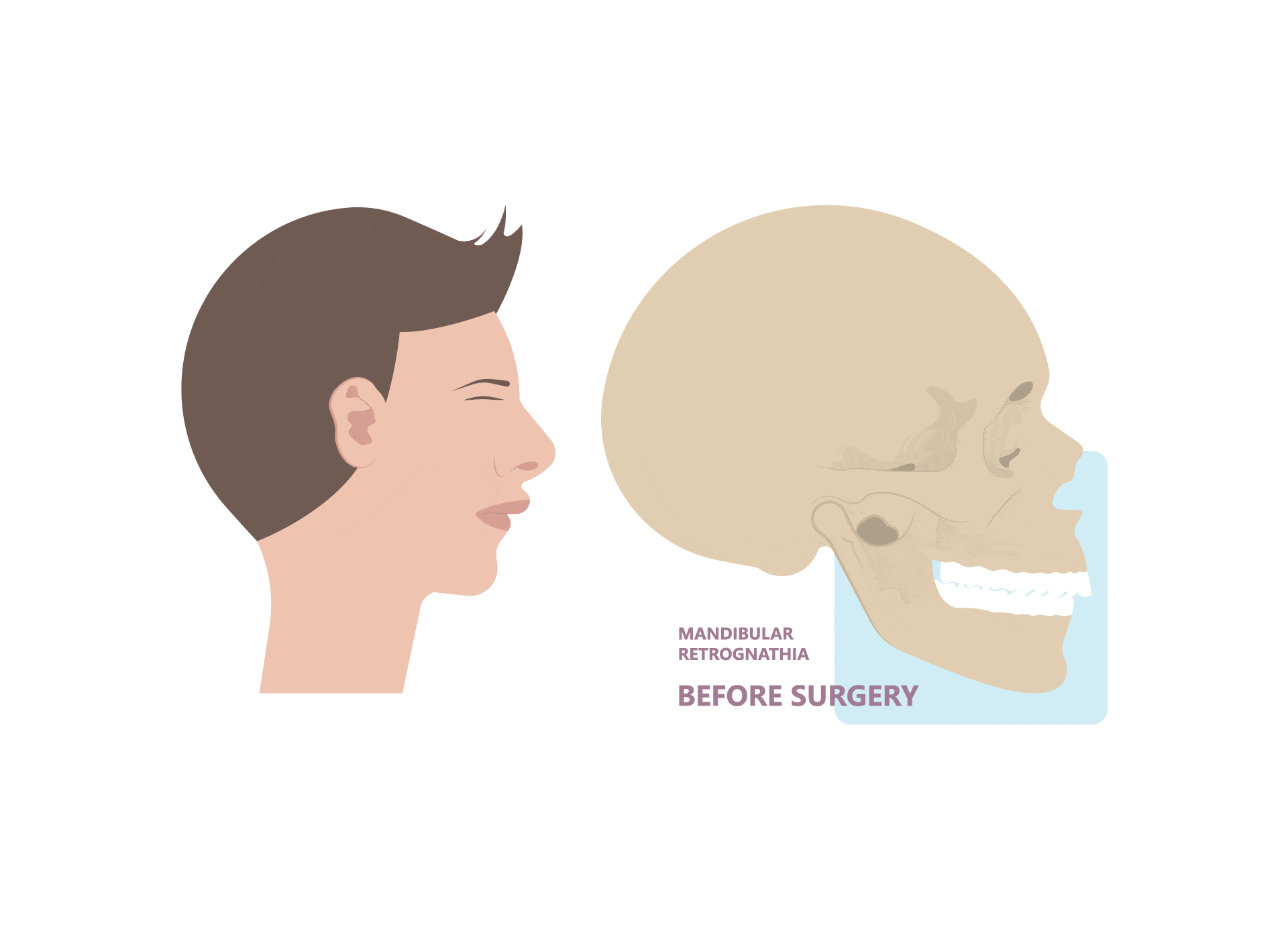
Mandibular retrognathia (or retrognathism) is a discrepancy between the jaws in which the lower jaw sits behind its normal position relative to the upper jaw. It can happen because the mandible is positioned further back or because it has not grown enough.
It is usually associated with a Class II malocclusion: the upper teeth sit well in front of the lower ones. In profile, the chin looks weak or receding. In a sense it is the opposite of prognathism, where the lower jaw sticks out.
Retruded lower jaw or retruded upper jaw?
They are not the same. When it is the upper jaw that is set back (maxillary retrusion), the opposite problem usually appears: the lower teeth sit in front of the upper ones, and the lower jaw looks prominent even when it is not. That is why diagnosis requires an examination and X-rays: you cannot tell which bone is responsible just by looking.
| Mandibular retrognathia | Maxillary retrusion | Mandibular prognathism | |
|---|---|---|---|
| Which bone is affected | Lower jaw set back or small | Upper jaw set back | Lower jaw forward or large |
| Typical bite | Class II: upper teeth in front | Class III: lower teeth in front | Class III: lower teeth in front |
| Profile | Receding chin, convex profile | Flat midface | Prominent chin, concave profile |
How do you know if you have retrognathia?
These are the most common signs:
- A weak or receding chin when seen in profile.
- Upper front teeth sitting well ahead of the lower ones.
- Difficulty closing the lips without effort.
- Tooth wear or discomfort in the jaw joint (TMJ).
- Snoring or mouth breathing.
Only a specialist can confirm it, with an examination and, if needed, a lateral cephalometric X-ray.
Causes of retrognathia
It is a multifactorial condition:
- Genetics: the shape and size of the jaws are largely inherited, so it often runs in families.
- Developmental conditions: some congenital conditions, such as Pierre Robin sequence, involve a very small lower jaw and breathing problems from birth.
- Childhood habits: prolonged thumb sucking or dummy use does not cause a small jaw on its own, but it can worsen a Class II bite. Read more about the consequences of thumb sucking.
- Trauma: a hard blow to the jaw during growth can affect its development.
Consequences of a retruded jaw
- Facial appearance: a profile with little chin, which affects many people’s confidence, especially during adolescence.
- Bite and chewing: incorrect contact between the teeth, abnormal wear and a higher risk of injury to the upper front teeth, which stick out.
- Temporomandibular joint: it can contribute to pain and discomfort in the TMJ. See our bruxism and TMJ treatment.
- Breathing: a retruded lower jaw reduces airway space and is linked to snoring and sleep apnoea.
- Speech and swallowing: in some cases it makes certain sounds or swallowing more difficult.
Retrognathia in babies and children
In newborns it is normal for the lower jaw to be slightly set back: it grows forward during the first months of life. Only when the retrusion is very marked, or the baby has trouble feeding or breathing, should the paediatrician assess it.
In children, the good news is that the jaws are still growing, which means much more can be corrected with less. That is why a first orthodontic check-up is worthwhile even while they still have baby teeth. At Clínicas Udemax, orthodontics for children is provided at Arcdental, our children’s clinic.
Our adviceFirst check-up at around age 6-7
Until what age does the lower jaw grow?
The lower jaw keeps growing until the end of adolescence, earlier in girls than in boys. The most useful window for guiding its growth is the pubertal growth spurt. Once growth has finished, orthodontics can no longer change the size of the bone: it can only move the teeth.
Think your child may have a retruded jaw? We assess it free of charge at Arcdental
Book your free first visitRetrognathia treatment
Treatment depends on the patient’s age and how severe the case is.
In growing children and teenagers
Functional appliances that encourage the lower jaw forward are used, combined with orthodontics. A Cochrane review concludes that these appliances reduce the protrusion of the upper front teeth, and that early treatment, between ages 7 and 11, lowers the risk of injury to the incisors (Batista et al., 2018). The orthodontist decides the timing and type of appliance according to each child’s skeletal age.
In adults with mild retrognathia
It can often be compensated with camouflage orthodontics: the teeth are repositioned to achieve a good bite, even though the bone does not change.
In adults with marked skeletal retrognathia
The solution is orthognathic surgery, planned in three phases:
- Pre-surgical orthodontics: aligns the arches and prepares the bite for surgery.
- Orthognathic surgery: the maxillofacial surgeon advances the lower jaw into its correct position, guided by a custom splint made from the digital planning of the case.
- Post-surgical orthodontics: fine-tunes the bite. Follow-up visits are then made to monitor the stability of the result.
In some cases a genioplasty (chin surgery) is also considered. It improves chin projection but does not correct the position of the jaw.
Can a retruded jaw be corrected without surgery?
Yes, in two situations: in children and teenagers who are still growing, with functional appliances and orthodontics, and in adults with mild cases, through camouflage orthodontics. When the bone discrepancy is significant and growth has finished, surgery is the only way to change the position of the jaw.
Retrognathia treatment at Clínicas Udemax
- Children and teenagers: the children’s orthodontics team at Arcdental assesses growth and decides whether to treat now or wait.
- Adults: diagnosis and planning are carried out jointly by orthodontics and maxillofacial surgery. Surgery is performed at Udemax Miramar, inside Hospital Juaneda Miramar.
We will explain which option makes sense in your case, with no obligation
Book your free first visitFrequently asked questions about retrognathia
What is the opposite of prognathism?
Retrognathia. In prognathism the lower jaw sticks out; in retrognathia it sits further back.
Does mild retrognathia need treatment?
Not always. If it does not affect the bite, the jaw joint or breathing, monitoring may be enough. In children it is worth assessing early, because that is when it is easiest to correct.
At what age should a retruded jaw be treated in children?
It depends on each case. A first check-up is recommended at around age 6-7, and functional appliances tend to be most effective during the pubertal growth spurt.
Can a retruded jaw cause sleep apnoea?
It can contribute, because it reduces airway space. If there is loud snoring or pauses in breathing during sleep, it is worth having it assessed.
How long does retrognathia treatment take?
It varies a lot with age and severity. In children there is usually a phase with a functional appliance followed by orthodontics. In adults having surgery, the process includes orthodontics before and after the operation. At your first visit we will give you an estimate for your case.
How much does retrognathia treatment cost?
It depends on age, severity and whether surgery is needed. At your free first visit we explain the treatment plan and give you a detailed quote.


