Does teeth whitening weaken the teeth?
En este artículo
- Quick answer: Does teeth whitening weaken your teeth?
- Why is it thought that teeth whitening weakens the teeth?
- What actually happens to the enamel when you whiten your teeth
- Types of teeth whitening and their actual risks
- When can teeth whitening actually be a problem?
- How your teeth and gums recover after a whitening treatment
- Tips for whitening your teeth without damaging the enamel
- Conclusion: myth debunked
If you’re thinking about having your teeth whitened but are worried that the procedure might weaken them, you’ve come to the right place. In this guide, we’ll debunk one of the most persistent myths in cosmetic dentistry and explain what the science actually says on this subject.
Quick answer: Does teeth whitening weaken your teeth?
No. Professional teeth whitening, such as that carried out at Udemax Clinics in Mallorca, does not weaken the teeth or wear down the enamel. Scientific studies using techniques such as electron microscopy and X-ray diffraction have shown that treatments using controlled hydrogen peroxide do not alter the internal structure or the physicochemical properties of the tooth.
The real risk arises when home remedies are overused without dental supervision: excessive use of over-the-counter whitening strips, online kits of unknown strength, or remedies such as bicarbonate of soda and lemon, which can actually erode the tooth surface.
The tooth sensitivity experienced by between 60% and 80% of patients following teeth whitening is temporary. It usually disappears within 24–72 hours thanks to the natural remineralisation provided by saliva. This discomfort does not mean that the tooth has become ‘thinner’ or weaker.
If your mouth is healthy and the treatment is properly planned by a dentist, teeth whitening is safe. In this article, we’ll take a closer look at how the process works, when it can cause problems, and how to do it safely at our teeth whitening clinics in Mallorca.
Why is it thought that teeth whitening weakens the teeth?
It is a widespread myth in Spain and here in Mallorca too, fuelled mainly by bad experiences with unregulated products and by confusion between sensitivity and structural damage.
When someone feels a sharp twinge after drinking cold water following treatment, it is easy to interpret that sensation as a loss of enamel. But the truth is that it is a reversible irritation of the dental nerve, not a weakening of the tooth.
Harsh home remedies also fuel the myth:
- Bicarbonate of soda with lemon: acidic pH (~2.2) which dissolves tooth enamel
- Highly abrasive activated carbon: RDA greater than 100, creates microscopic grooves
- Coarse abrasives: wear down by up to 5–10 micrometres per month of continuous use
Comments on social media and forums, taken out of clinical context, reinforce the idea that any form of teeth whitening is dangerous. However, European dental associations and EU regulations confirm that supervised treatments are safe provided that the correct concentrations and protocols are followed.
What actually happens to the enamel when you whiten your teeth
Enamel is the hardest layer of the human body, with a hardness similar to that of quartz. Whitening does not ‘file’ or wear it down: it acts chemically on internal stains.
Whitening agents such as hydrogen peroxide or carbamide peroxide release oxygen radicals that penetrate the enamel prisms (up to 1–2 mm) and oxidise the intracrystalline organic pigments. This process does not remove layers of tooth structure or dissolve minerals.
Studies using 38% concentrations showed that neither the X-ray diffraction patterns nor the chemical composition of the enamel were altered (calcium/phosphorus ratio remained stable at ~1.67). Surface changes are minimal and transient.
It is important to note that teeth whitening does not change the colour of fillings, crowns or veneers. This sometimes makes it necessary to replace restorations in order to achieve a consistent aesthetic result as part of an overall dental aesthetics plan.
Sensitivity occurs because the pores in the enamel open up temporarily, allowing external stimuli to reach the dentine more easily. This side effect is reversed within a few days through natural remineralisation.
Does teeth whitening damage the enamel?
In clinical practice, peroxide concentrations (up to 35–40% under isolation and controlled conditions) are adjusted so as not to cause enamel wear. The microscopic changes described in studies are temporary and are reversed through remineralisation.
Factor | Does it damage the enamel? |
|---|---|
Professional, supervised teeth whitening | No (reversible changes) |
Acidic soft drinks (pH < 5.5) | Yes (up to 50 μm/year) |
Bruxism | Yes (20–100 μm loss) |
Very vigorous brushing | Yes (5–10 μm/month) |
Compulsive use of home teeth-whitening products | Yes (up to 30 μm with repeated use) |
At Udemax Clinics, we combine whitening treatments with fluoride, calcium or nano-hydroxyapatite to strengthen the enamel after each session, restoring the surface microhardness within 7–14 days.
Types of teeth whitening and their actual risks
There are three main methods: in-clinic treatment, supervised home treatment, and products available from pharmacies or online. The level of safety depends on the concentration of the active ingredient, the contact time and, above all, professional supervision.
Before undergoing any type of teeth whitening, it is essential to have an assessment to rule out any cavities, cracks or gum disease that could complicate the treatment.
In-clinic (professional) teeth whitening
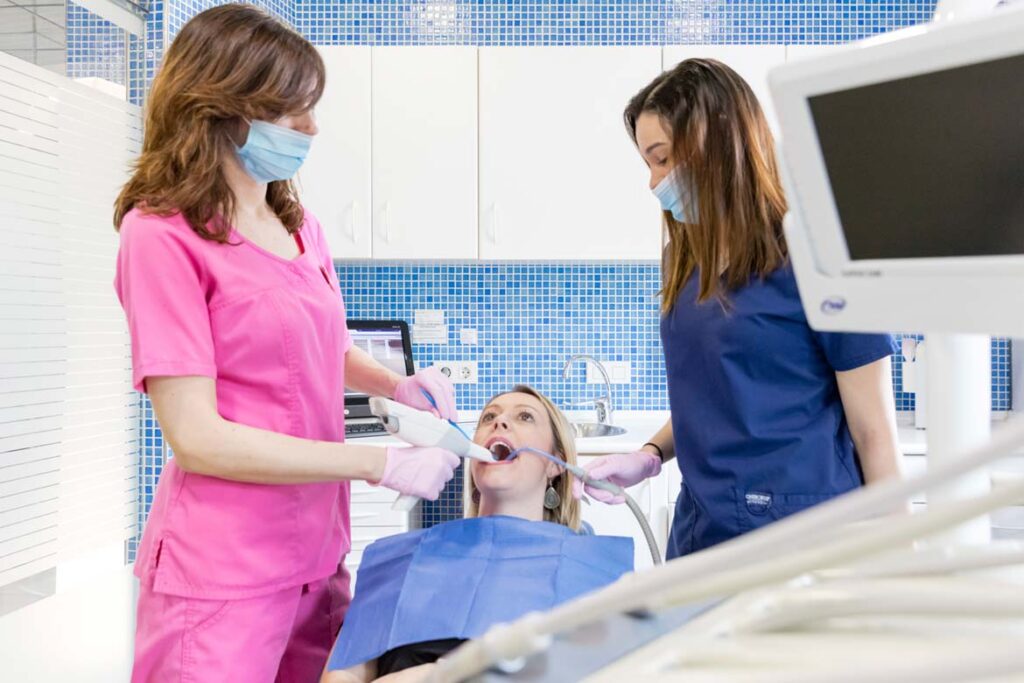
The procedure is carried out in the dentist’s surgery, where the dentist applies a high-concentration gel (25–40% H₂O₂) to the teeth, protecting the gums and soft tissues with a special barrier.
At Udemax Clinics, this can be combined with LED cold light teeth whitening using a cold LED lamp (wavelength 450–490 nm), which accelerates the oxidation process by 20–50%.
The risk of nerve damage is minimal provided the recommended treatment times are adhered to (15–20 minutes per session, 1–3 sessions). Sensitivity is usually mild and can be managed with desensitising gels; it resolves in 90% of patients within 24–48 hours.
Supervised home whitening
Use custom-made teeth-whitening trays and lower-concentration gels (10–22% carbamide) to be worn at home for several hours a day or overnight.
The dentist plans the total duration (for example, 10–14 days) and monitors progress through regular check-ups. When properly managed, this is a safe option that helps maintain or enhance the results of in-clinic whitening.
Continuing treatment on your own or reusing old gels without checking them increases the risk of persistent sensitivity and discomfort.
Pharmacy products, online purchases and home remedies
Over-the-counter whitening strips, pens and special toothpastes have concentrations limited by European regulations (0.1–6% for OTC products). When used occasionally, many are safe.
However, overuse or use without a diagnosis can exacerbate sensitivity or gum problems. 20% of regular users of whitening strips develop erosion, compared with 0% in professional treatments.
In particular, avoid:
- Kits of dubious origin purchased online with unknown concentrations
- Abrasive or acidic “natural” remedies: lemon, vinegar, bicarbonate of soda
- Highly abrasive activated carbon (RDA >200) that creates grooves on the surface
When can teeth whitening actually be a problem?
Teeth whitening isn’t for everyone. There are circumstances in which it may be contraindicated or require special precautions, such as in teeth that have darkened following root canal treatment, which may benefit from internal teeth whitening in Mallorca – something we assess on a case-by-case basis at our clinic.
Situations in which it is advisable to avoid or postpone teeth whitening
Situation | Reason |
|---|---|
Ages 16–18 | Developing enamel and pulp, wider tubules |
Pregnant women and breastfeeding mothers | Medical caution, increased gum sensitivity |
Active cavities or fractures | The peroxide penetrates and causes pulp inflammation |
Periodontal disease | Risk of irritation and complications |
Enamel that is very worn | Bruxism, prior acid erosion |
Previous history of severe hypersensitivity | Worsening of symptoms |
Risks associated with improper or excessive use
Overuse of teeth-whitening products — for example, repeating full treatments every few months — can cause persistent sensitivity in 20% of cases.
Incorrect application of the gel without protecting the gums can cause irritation or chemical burns to the oral mucosa. In extreme cases of uncontrolled, long-term use, changes to the surface of the enamel may occur, and the teeth may feel more brittle.
That is why at Udemax Clinics we set minimum intervals between treatments (6–12 months) and record the initial shade using a colour guide to avoid over-whitening in the pursuit of an unrealistic white.
How your teeth and gums recover after a whitening treatment
The mouth has a remarkable ability to recover. Following whitening, a natural remineralisation process is triggered, restoring the enamel’s balance.
Many of our patients in Palma de Mallorca report sensitivity only during the first 24–72 hours, with the discomfort peaking 4–6 hours after treatment. After that, it disappears completely in most cases.
Enamel remineralisation
Saliva provides calcium and phosphate (1–2 mM), which are key components in repairing micro-damage to the enamel. Normal salivary flow (0.3–0.5 ml/min) seals the open pores during the procedure.
To speed up this process:
- Toothpastes containing fluoride (1450 ppm) or hydroxyapatite
- Foods rich in calcium and vitamin D: dairy products, oily fish, green leafy vegetables
- Fluoride varnishes applied in the clinic at the end of the session
At Udemax Clinics, we apply remineralising products immediately after treatment, reducing symptoms by up to 50%.
Managing sensitivity after teeth whitening
The sensitivity is usually most intense in the first few hours and gradually subsides over 1–3 days. To manage it:
- Use specific desensitising toothpastes
- If recommended by your dentist, potassium nitrate gels (40–60% effective)
- Avoid very cold or hot drinks and acidic foods for at least 48 hours
- Avoid consuming things that stain: coffee, black tea, red wine
If the sensitivity is very severe or lasts for more than a week (only 1–2% of cases), please contact the clinic to discuss any adjustments.
Tips for whitening your teeth without damaging the enamel
The key isn’t to give up on teeth whitening, but to do it safely and in moderation. Here are some practical guidelines that we follow with our patients in Mallorca.
Before you whiten your teeth
- Book an appointment for a check-up at a reputable dental practice to have your teeth, gums and enamel checked
- Have it professionally cleaned beforehand to remove tartar and surface stains
- Record your starting shade using the Vita colour guide to ensure you don’t exceed natural limits
- Tell us about your habits (coffee, smoking, red wine) so we can plan a realistic treatment plan
During treatment
- Follow your dentist’s instructions regarding timing and frequency exactly
- Please let us know if you experience severe sensitivity so we can decide on the next steps
- Avoid strongly coloured foods and drinks for the first 48 hours
- Do not smoke during treatment so as not to compromise the results or the health of your gums
After the whitening treatment
Recommendation | Benefit |
|---|---|
Daily oral hygiene using a gentle technique | Delivers results without wear and tear |
Space out full-mouth whitening treatments (max. 1 per year) | Prevents cumulative sensitivity |
Regular check-ups at the clinic | Enamel control and colour stability |
Occasional supervised revisions | A radiant smile without the need for repeated intensive treatments |
Conclusion: myth debunked
Teeth whitening, when carried out by specialists and in moderation, does not weaken the teeth. The scientific evidence is clear: any superficial changes are temporary and are reversed by the mouth’s natural remineralisation process.
The real problem lies in the indiscriminate use of home remedies or kits without supervision, not in a properly planned treatment. Confusing temporary sensitivity with structural damage perpetuates a myth that has no scientific basis.
At our dental clinics in Mallorca, we assess each case individually. We examine your enamel, rule out any contraindications and recommend the safest and most effective whitening treatment to suit your lifestyle and expectations.
If you have any doubts about whether teeth whitening is right for you, we invite you to book an initial consultation. You can contact us by email or by calling the clinic directly. We’d be delighted to help you achieve the smile you want without compromising your oral health.
Because having naturally white teeth and looking after your enamel aren’t mutually exclusive. You just need the right professional.